Same string. Different jurisdictions.
The 2026 competition is not only concentrated. For most repeated primary strings, the listed applicant entities cross borders.
Analysis updated: 22 October 2026 (Pacific). Frozen CSV captured: 8 October 2026, 01:46 UTC. This is a new calculation, not new application-status data.
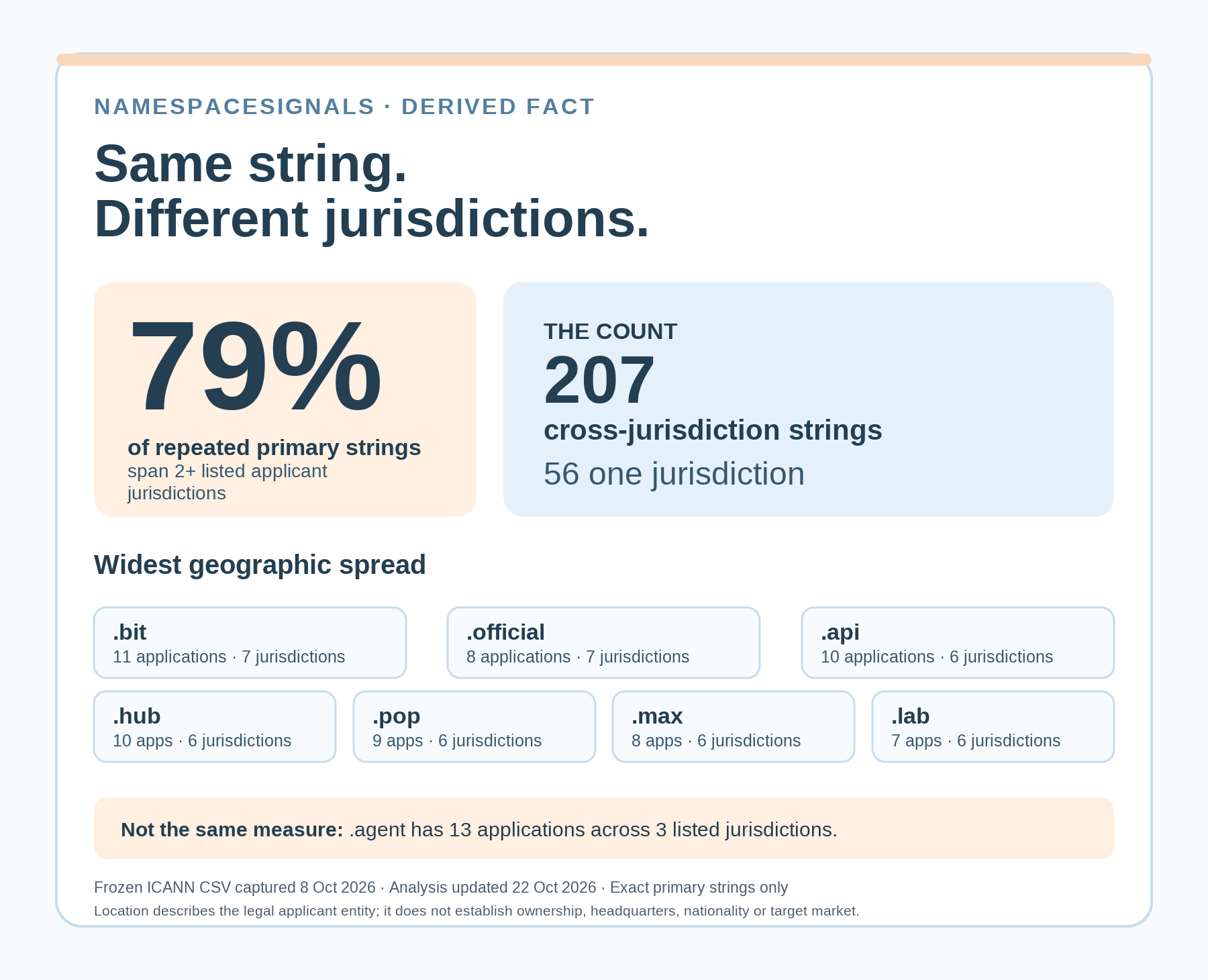
Most exact-name overlap crosses listed jurisdictions.
Of 263 exact primary strings with multiple applications, 207 include applicant entities from at least two listed jurisdictions. The remaining 56 stay within one listed jurisdiction.
The 207 cross-jurisdiction groups contain 765 of 891 applications in repeated-string groups (85.9%). Application records are not a count of people or operating groups.
Where the spread is widest
.bit
11 applications · 7 listed jurisdictions
HKIEITKYMTUSVG
.official
8 applications · 7 listed jurisdictions
CODEJPKYMCMTUS
.api
10 applications · 6 listed jurisdictions
HKIEKHKYMTUS
.hub
10 applications · 6 listed jurisdictions
BMIEKYLTMTUS
.pop
9 applications · 6 listed jurisdictions
CNIEITMTSGUS
.max
8 applications · 6 listed jurisdictions
CNIEKYMCMTUS
.lab
7 applications · 6 listed jurisdictions
HKIEITJPLTUS
A useful contrast: .agent has the most applications among repeated strings (13), but they are spread across only 3 listed jurisdictions (HK, KY, US). Application count and geographic spread are different measures.
What the result supports — and what it does not
Supported inference: exact same-string overlap in this frozen snapshot is frequently distributed across legal applicant entities listed in different jurisdictions.
Do not overread it: ICANN’s Location field does not establish an operating group’s headquarters, ownership, management, nationality or target market. Exact matching also does not cover visually or semantically similar strings, future replacement choices, withdrawals or the outcome of ICANN evaluations.
Find a repeated string. Inspect the jurisdictions.
207 strings match. Showing up to 30; narrow your search to inspect a specific string.
.bit11 primary applications · 7 listed jurisdictions
HKIEITKYMTUSVG
- Hong Kong Zhongze International Limited: HKZI2636T-T79772 (HK)
- ShortDot (Ireland) Limited: NA2626T-T67212 (IE)
- Aruba PEC S.P.A.: APEC2611T-T45326 (IT)
- Internet Naming Company: INC2624T-T96235 (KY)
- Radix Technologies Inc SEZC: RTIS2674T-T37415 (KY)
- Link Freedom Group Ltd: LFGL2683T-T55382 (MT)
- Duel Meaning, LLC: DM2627T-T34270 (US)
- Oinkadot Inc: OI2692T-T11525 (US)
- Registry Services, LLC: NA2631T-T45584 (US)
- XYZ.COM LLC: XL2625T-T23714 (US)
- Qaten Group Limited: QGL2682T-T10263 (VG)
Location codes come from the frozen ICANN application record. Links open public application responses, which may have changed since capture.
.official8 primary applications · 7 listed jurisdictions
CODEJPKYMCMTUS
- Cardelina Sociedad por Acciones Simplificada: CS2595-T95743 (CO)
- iRegistry GmbH: IG2663T-T85800 (DE)
- XServer Cloud Incorporated: XCI2688T-T22077 (JP)
- Radix Technologies Inc SEZC: RTIS2674T-T10767 (KY)
- Cam Connecting SARL: CCS2640T-T64563 (MC)
- Link Freedom Group Ltd: LFGL2683T-T54503 (MT)
- Vinyl Strings, LLC: VSL2633T-T77260 (US)
- XYZ.COM LLC: XL2625T-T64446 (US)
Location codes come from the frozen ICANN application record. Links open public application responses, which may have changed since capture.
.api10 primary applications · 6 listed jurisdictions
HKIEKHKYMTUS
- Elegant Leader Limited: ELL2677T-T16553 (HK)
- ShortDot (Ireland) Limited: NA2626T-T46346 (IE)
- OPEN DEVELOPMENT CAMBODIA: ODC2534-T66083 (KH)
- Internet Naming Company: INC2624T-T91582 (KY)
- Link Freedom Group Ltd: LFGL2683T-T89949 (MT)
- Charleston Road Registry Inc.: CRRI2564-T68962 (US)
- ECHO Domain Co L.L.C.: EDCL2689T-T68091 (US)
- Heir Superiority, LLC: HS2699T-T83167 (US)
- Registry Services, LLC: NA2631T-T30375 (US)
- XYZ.COM LLC: XL2625T-T58281 (US)
Location codes come from the frozen ICANN application record. Links open public application responses, which may have changed since capture.
.hub10 primary applications · 6 listed jurisdictions
BMIEKYLTMTUS
- HUB Culture Ltd: HCL2645T-T37673 (BM)
- ShortDot (Ireland) Limited: NA2626T-T65696 (IE)
- Intercap Registry Inc.: IRI2679T-T67954 (KY)
- Radix Technologies Inc SEZC: RTIS2674T-T28113 (KY)
- Hostinger UAB: HU2684T-T32145 (LT)
- Link Freedom Group Ltd: LFGL2683T-T31500 (MT)
- Empty Hand, LLC: SL2641T-T21323 (US)
- Registry Services, LLC: NA2631T-T57019 (US)
- Squarespace Registry LLC: SRL2616T-T36153 (US)
- XYZ.COM LLC: XL2625T-T57527 (US)
Location codes come from the frozen ICANN application record. Links open public application responses, which may have changed since capture.
.pop9 primary applications · 6 listed jurisdictions
CNIEITMTSGUS
- Beijing Guoxu Network Technology Co., Ltd.: BGNT2696T-T98747 (CN)
- ShortDot (Ireland) Limited: NA2626T-T90969 (IE)
- Aruba PEC S.P.A.: APEC2611T-T63430 (IT)
- Link Freedom Group Ltd: LFGL2683T-T14279 (MT)
- NETDREAM PTE. LTD.: NPL2622T-T38794 (SG)
- Knock Knock WHOIS There, LLC: KKWT2621T-T54515 (US)
- Registry Services, LLC: NA2631T-T74744 (US)
- Vanity Check, LLC: VC2665T-T57535 (US)
- XYZ.COM LLC: XL2625T-T34903 (US)
Location codes come from the frozen ICANN application record. Links open public application responses, which may have changed since capture.
.max8 primary applications · 6 listed jurisdictions
CNIEKYMCMTUS
- Hangzhou Shuniu Cloud Computing Co., Ltd.: HSCC2561-T49850 (CN)
- ShortDot (Ireland) Limited: NA2626T-T72994 (IE)
- Intercap Registry Inc.: IRI2679T-T72982 (KY)
- Cam Connecting SARL: CCS2640T-T75373 (MC)
- Link Freedom Group Ltd: LFGL2683T-T33637 (MT)
- Paws Button, LLC: PB2674T-T80276 (US)
- Registry Services, LLC: NA2631T-T74369 (US)
- XYZ.COM LLC: XL2625T-T53882 (US)
Location codes come from the frozen ICANN application record. Links open public application responses, which may have changed since capture.
.lab7 primary applications · 6 listed jurisdictions
HKIEITJPLTUS
- Make A Difference Institute Limited: MADI2580-T89840 (HK)
- ShortDot (Ireland) Limited: NA2626T-T54761 (IE)
- Aruba PEC S.P.A.: APEC2611T-T95731 (IT)
- Interlink Systems Innovation Institute K.K.: ISII2617T-T57898 (JP)
- Hostinger UAB: HU2684T-T81042 (LT)
- Squarespace Registry LLC: SRL2616T-T44072 (US)
- Wezen Exploration, Inc.: WEI2642T-T36415 (US)
Location codes come from the frozen ICANN application record. Links open public application responses, which may have changed since capture.
.brand10 primary applications · 5 listed jurisdictions
CNJPKYMTUS
- Internet DotTrademark Organisation Limited: IDOL2621T-T20061 (CN)
- XServer Cloud Incorporated: XCI2688T-T81155 (JP)
- Intercap Registry Inc.: IRI2679T-T15412 (KY)
- Radix Technologies Inc SEZC: RTIS2674T-T83546 (KY)
- Link Freedom Group Ltd: LFGL2683T-T94977 (MT)
- M&A Entity LLC: MEL2626T-T48733 (US)
- Registry Services, LLC: NA2631T-T69341 (US)
- Squarespace Registry LLC: SRL2616T-T86558 (US)
- Velvet Taupe, LLC: VTL2632T-T88824 (US)
- XYZ.COM LLC: XL2625T-T31633 (US)
Location codes come from the frozen ICANN application record. Links open public application responses, which may have changed since capture.
.key7 primary applications · 5 listed jurisdictions
HKIEJPMTUS
- LeapSense Limited: LL2624T-T70470 (HK)
- ShortDot (Ireland) Limited: NA2626T-T31004 (IE)
- XRegistry Incorporated: XI2694T-T18057 (JP)
- Link Freedom Group Ltd: LFGL2683T-T28609 (MT)
- Heir Superiority, LLC: HS2699T-T48600 (US)
- Registry Services, LLC: NA2631T-T58531 (US)
- XYZ.COM LLC: XL2625T-T48854 (US)
Location codes come from the frozen ICANN application record. Links open public application responses, which may have changed since capture.
.therapy7 primary applications · 5 listed jurisdictions
CAKYMTMUUS
- 101130013 Saskatchewan Ltd.: MLG2688T-T30008 (CA)
- Radix Technologies Inc SEZC: RTIS2674T-T50362 (KY)
- Link Freedom Group Ltd: LFGL2683T-T79768 (MT)
- Emotiva Ltd: EL2578-T58918 (MU)
- Registry Services, LLC: NA2631T-T33266 (US)
- Toddler Logic, LLC: TT2652T-T33391 (US)
- XYZ.COM LLC: XL2625T-T84804 (US)
Location codes come from the frozen ICANN application record. Links open public application responses, which may have changed since capture.
.fix6 primary applications · 5 listed jurisdictions
IEITKYSCUS
- ShortDot (Ireland) Limited: NA2626T-T48225 (IE)
- Aruba PEC S.P.A.: APEC2611T-T67575 (IT)
- Radix Technologies Inc SEZC: RTIS2674T-T29496 (KY)
- Innovation Service Limited: ISL2626T-T82788 (SC)
- Registry Services, LLC: NA2631T-T72857 (US)
- Rein Check, LLC: RC2677T-T79526 (US)
Location codes come from the frozen ICANN application record. Links open public application responses, which may have changed since capture.
.gaming6 primary applications · 5 listed jurisdictions
DEJPKYMCUS
- ULTRAVIEW AG: UA2620T-T78897 (DE)
- XServer Cloud Incorporated: XCI2688T-T62426 (JP)
- Intercap Registry Inc.: IRI2679T-T68212 (KY)
- Cam Connecting SARL: CCS2640T-T43697 (MC)
- Acid Medal, LLC: AM2619T-T51241 (US)
- XYZ.COM LLC: XL2625T-T25851 (US)
Location codes come from the frozen ICANN application record. Links open public application responses, which may have changed since capture.
.good6 primary applications · 5 listed jurisdictions
HKIEKYMTUS
- LeapSense Limited: LL2624T-T62551 (HK)
- ShortDot (Ireland) Limited: NA2626T-T32387 (IE)
- Intercap Registry Inc.: IRI2679T-T44197 (KY)
- Link Freedom Group Ltd: LFGL2683T-T33008 (MT)
- Mystic Hammer, LLC: MH2645T-T95364 (US)
- Registry Services, LLC: NA2631T-T44826 (US)
Location codes come from the frozen ICANN application record. Links open public application responses, which may have changed since capture.
.portal6 primary applications · 5 listed jurisdictions
AEBDKYMTUS
- VANT NEXUS TECHNOLOGIES LLC: VNTL2649T-T52249 (AE)
- VISER X LIMITED: NA2555-T61680 (BD)
- Intercap Registry Inc.: IRI2679T-T41564 (KY)
- Link Freedom Group Ltd: LFGL2683T-T30117 (MT)
- Arctic Tan, LLC: AT2680T-T16295 (US)
- XYZ.COM LLC: XL2625T-T16424 (US)
Location codes come from the frozen ICANN application record. Links open public application responses, which may have changed since capture.
.share6 primary applications · 5 listed jurisdictions
CNDEKYMTUS
- Ningbo Lingjie Technology Co., Ltd.: NLTC2529-T64442 (CN)
- NextGEN TLDs GmbH: NTG2671T-T12150 (DE)
- Intercap Registry Inc.: IRI2679T-T75119 (KY)
- Link Freedom Group Ltd: LFGL2683T-T66821 (MT)
- Charleston Road Registry Inc.: CRRI2564-T63180 (US)
- Suffix Inc.: SI2639T-T42447 (US)
Location codes come from the frozen ICANN application record. Links open public application responses, which may have changed since capture.
.get5 primary applications · 5 listed jurisdictions
IEJPKYMTUS
- ShortDot (Ireland) Limited: NA2626T-T22589 (IE)
- XRegistry Incorporated: XI2694T-T41185 (JP)
- Intercap Registry Inc.: IRI2679T-T36278 (KY)
- Link Freedom Group Ltd: LFGL2683T-T54628 (MT)
- Berth Order, LLC: A2619T-T76756 (US)
Location codes come from the frozen ICANN application record. Links open public application responses, which may have changed since capture.
.way5 primary applications · 5 listed jurisdictions
DEIEKYMTUS
- NextGEN TLDs GmbH: NTG2671T-T59664 (DE)
- ShortDot (Ireland) Limited: NA2626T-T72240 (IE)
- TechEdge Limited: TL2645T-T45834 (KY)
- Link Freedom Group Ltd: LFGL2683T-T10634 (MT)
- XYZ.COM LLC: XL2625T-T81913 (US)
Location codes come from the frozen ICANN application record. Links open public application responses, which may have changed since capture.
.yes5 primary applications · 5 listed jurisdictions
DEIEITKYMT
- NextGEN TLDs GmbH: NTG2671T-T67583 (DE)
- ShortDot (Ireland) Limited: NA2626T-T19698 (IE)
- Aruba PEC S.P.A.: APEC2611T-T13650 (IT)
- Intercap Registry Inc.: IRI2679T-T72228 (KY)
- Link Freedom Group Ltd: LFGL2683T-T42310 (MT)
Location codes come from the frozen ICANN application record. Links open public application responses, which may have changed since capture.
.robot9 primary applications · 4 listed jurisdictions
CNKYMTUS
- Pingyang Chamber of Commerce in Haishu District of Ningbo: PCOC2554-T97118 (CN)
- Intercap Registry Inc.: IRI2679T-T49225 (KY)
- Ipollo Tech Ltd: ITL2677T-T15916 (KY)
- Link Freedom Group Ltd: LFGL2683T-T19307 (MT)
- Internet Land & Cattle LLC: ILCL2673T-T48612 (US)
- Knock Knock WHOIS There, LLC: KKWT2621T-T94110 (US)
- Paws Button, LLC: PB2674T-T61547 (US)
- Registry Services, LLC: NA2631T-T22456 (US)
- Zero Gravity Labs Inc.: A2652T-T75760 (US)
Location codes come from the frozen ICANN application record. Links open public application responses, which may have changed since capture.
.zen8 primary applications · 4 listed jurisdictions
IEKYMCUS
- ShortDot (Ireland) Limited: NA2626T-T98888 (IE)
- Intercap Registry Inc.: IRI2679T-T80147 (KY)
- Radix Technologies Inc SEZC: RTIS2674T-T25222 (KY)
- TechEdge Limited: TL2645T-T30242 (KY)
- Cam Connecting SARL: CCS2640T-T99130 (MC)
- Paws Button, LLC: PB2674T-T11142 (US)
- Registry Services, LLC: NA2631T-T43068 (US)
- XYZ.COM LLC: XL2625T-T31508 (US)
Location codes come from the frozen ICANN application record. Links open public application responses, which may have changed since capture.
.agi7 primary applications · 4 listed jurisdictions
IEKYMTUS
- ShortDot (Ireland) Limited: NA2626T-T14670 (IE)
- Radix Technologies Inc SEZC: RTIS2674T-T70599 (KY)
- Link Freedom Group Ltd: LFGL2683T-T50354 (MT)
- Cold Fleet, LLC: CFL2645T-T71728 (US)
- OPENAI OPCO, LLC: OOL2614T-T13416 (US)
- Registry Services, LLC: NA2631T-T14537 (US)
- Zero Gravity Labs Inc.: A2652T-T59922 (US)
Location codes come from the frozen ICANN application record. Links open public application responses, which may have changed since capture.
.ask7 primary applications · 4 listed jurisdictions
IEITKYUS
- ShortDot (Ireland) Limited: NA2626T-T63059 (IE)
- Aruba PEC S.P.A.: APEC2611T-T29488 (IT)
- Intercap Registry Inc.: IRI2679T-T73736 (KY)
- Charleston Road Registry Inc.: CRRI2564-T61043 (US)
- ECHO Domain Co L.L.C.: EDCL2689T-T29879 (US)
- Registry Services, LLC: NA2631T-T95989 (US)
- Suffix Inc.: SI2639T-T44584 (US)
Location codes come from the frozen ICANN application record. Links open public application responses, which may have changed since capture.
.connect7 primary applications · 4 listed jurisdictions
CAMCSCUS
- 101130013 Saskatchewan Ltd.: MLG2688T-T93360 (CA)
- Cam Connecting SARL: CCS2640T-T56644 (MC)
- Innovation Service Limited: ISL2626T-T74869 (SC)
- ECHO Domain Co L.L.C.: EDCL2689T-T77393 (US)
- Registry Services, LLC: NA2631T-T87316 (US)
- Toddler Logic, LLC: TT2652T-T94606 (US)
- XYZ.COM LLC: XL2625T-T79147 (US)
Location codes come from the frozen ICANN application record. Links open public application responses, which may have changed since capture.
.firm7 primary applications · 4 listed jurisdictions
KYMTSGUS
- Radix Technologies Inc SEZC: RTIS2674T-T42193 (KY)
- Link Freedom Group Ltd: LFGL2683T-T30871 (MT)
- NETDREAM PTE. LTD.: NPL2622T-T22956 (SG)
- Neigh Sayer, LLC: NS2662T-T95360 (US)
- Registry Services, LLC: NA2631T-T79393 (US)
- Squarespace Registry LLC: SRL2616T-T94477 (US)
- XYZ.COM LLC: XL2625T-T17932 (US)
Location codes come from the frozen ICANN application record. Links open public application responses, which may have changed since capture.
.vibe7 primary applications · 4 listed jurisdictions
CAKYMTUS
- 101130013 Saskatchewan Ltd.: MLG2688T-T19198 (CA)
- Intercap Registry Inc.: IRI2679T-T24714 (KY)
- Radix Technologies Inc SEZC: RTIS2674T-T22331 (KY)
- Link Freedom Group Ltd: LFGL2683T-T61039 (MT)
- Knock Knock WHOIS There, LLC: KKWT2621T-T46596 (US)
- Paws Button, LLC: PB2674T-T93223 (US)
- Registry Services, LLC: NA2631T-T64938 (US)
Location codes come from the frozen ICANN application record. Links open public application responses, which may have changed since capture.
.gen6 primary applications · 4 listed jurisdictions
ITLTMTUS
- Aruba PEC S.P.A.: APEC2611T-T55511 (IT)
- Hostinger UAB: HU2684T-T42201 (LT)
- Link Freedom Group Ltd: LFGL2683T-T46709 (MT)
- Gen Digital Inc. : GEN2685T-T72482 (US)
- Heir Superiority, LLC: HS2699T-T32762 (US)
- XYZ.COM LLC: XL2625T-T49608 (US)
Location codes come from the frozen ICANN application record. Links open public application responses, which may have changed since capture.
.labs6 primary applications · 4 listed jurisdictions
KYMTSGUS
- Radix Technologies Inc SEZC: RTIS2674T-T67708 (KY)
- Link Freedom Group Ltd: LFGL2683T-T36528 (MT)
- Dot Digital Networks Pte. Ltd.: DDNP2635T-T57777 (SG)
- Hair Apparent, LLC: SS2654T-T60797 (US)
- Registry Services, LLC: NA2631T-T99126 (US)
- XYZ.COM LLC: XL2625T-T80530 (US)
Location codes come from the frozen ICANN application record. Links open public application responses, which may have changed since capture.
.omg6 primary applications · 4 listed jurisdictions
IEKYMTUS
- ShortDot (Ireland) Limited: NA2626T-T38427 (IE)
- Intercap Registry Inc.: IRI2679T-T96739 (KY)
- Link Freedom Group Ltd: LFGL2683T-T62422 (MT)
- Duel Meaning, LLC: DM2627T-T65946 (US)
- Registry Services, LLC: NA2631T-T98126 (US)
- XYZ.COM LLC: XL2625T-T43072 (US)
Location codes come from the frozen ICANN application record. Links open public application responses, which may have changed since capture.
.hello5 primary applications · 4 listed jurisdictions
ITKYMTUS
- Aruba PEC S.P.A.: APEC2611T-T61164 (IT)
- Intercap Registry Inc.: IRI2679T-T88324 (KY)
- Link Freedom Group Ltd: LFGL2683T-T89824 (MT)
- ECHO Domain Co L.L.C.: EDCL2689T-T42826 (US)
- NAME SPACE LLC: NSL2674T-T80030 (US)
Location codes come from the frozen ICANN application record. Links open public application responses, which may have changed since capture.
.merch5 primary applications · 4 listed jurisdictions
CAKYMTUS
- 101130013 Saskatchewan Ltd.: MLG2688T-T45846 (CA)
- Intercap Registry Inc.: IRI2679T-T88820 (KY)
- Radix Technologies Inc SEZC: RTIS2674T-T23464 (KY)
- Link Freedom Group Ltd: LFGL2683T-T41556 (MT)
- Bird Pepper, LLC: BPL2623T-T20698 (US)
Location codes come from the frozen ICANN application record. Links open public application responses, which may have changed since capture.
Questions to take into the room
- Do applicants in different listed jurisdictions intend to serve the same users or markets?
- Which cross-border overlaps involve related corporate groups, and which appear independent?
- How will evaluation, replacement choices and withdrawals change the exact-name picture?
These are research questions, not conclusions established by the Location field.
Download and check the calculation
Sources, dates and counting rules
Source publication: ICANN’s 7 October 2026 application publication. ICANN application list. The retained CSV was captured on 8 October 2026 at 01:46 UTC.
Exclude records whose Application Type is Replacement String; retain variant application types. Count each of 1,614 primary application IDs once. Normalize each primary string by trimming whitespace and converting it to lowercase. Of 986 distinct primary strings, 263 have more than one primary application.
For each repeated string, count distinct non-empty Location values on its application records. A group enters the cross-jurisdiction count when it has two or more distinct values. The values are displayed as the two-letter codes in the source data.
All 891 application IDs in these 263 exact repeated-string groups also match the frozen ICANN contention-set groupings used by this site. This is an internal consistency check, not a live status check.
Jurisdiction describes the legal applicant entity’s listed location. It is not a finding about the operating group’s headquarters, beneficial ownership, management, nationality, audience or commercial intent. Exact same-string matching is not similar-string analysis.