What is already hiding in your customer base?
A registry can pitch a launch story. A registrar can test whether that story fits the domains and customers it already manages.
The registrar with the largest book may not have the largest opportunity.
A smaller registrar with strong concentration in the right vertical, geography, language or naming pattern may be able to drive more relevant adoption than a larger registrar with weak fit. The evidence has to come from the registrar’s own aggregated customer data.
Three evidence layers. Do not mix them.
Public context
ICANN application data, public per-registrar transaction reports, current TLD mix, applicant relationships and launch milestones.
Useful for scale and context.Registrar-only evidence
Managed domains, privacy-preserving customer IDs, renewals, customer-supplied industry information, product usage and geography.
Useful for customer fit.Derived opportunity questions
Adjacency, shortening, customer reach, renewal strength, defensive exposure and campaign-ready cohorts.
Useful for planning—not forecasting.The questions worth calculating
Portfolio adjacency
How many managed domains contain, begin with, end with or semantically match a proposed extension?
Start with exact matches. Keep semantic matches separate and reviewable.Shortening potential
How many current domains could become 5, 10 or 15+ characters shorter?
Compare complete current and candidate domains. Availability and customer preference remain unknown.Customer reach
How many unique customer accounts—not just domains—have at least one plausible match?
Separate a broad customer opportunity from a few large portfolio holders.Renewal strength
Do matching domains renew more consistently than the registrar baseline?
A historical cohort can signal importance, but cannot predict uptake.Observed use
Are the matching domains configured for websites, email, redirects, parking or no observable service?
Configuration is a limited proxy for business importance.Defensive exposure
Which customers protect the same label across several existing extensions?
Multiple holdings do not prove defensive intent, but they identify a question worth asking.Vertical fit
Which industries in the customer base align with each proposed extension?
Use customer-supplied or carefully governed classifications; do not invent an industry from a name alone.Channel leverage
What aggregate evidence can the registrar bring into launch and co-marketing negotiations?
Relevance is not a registration, revenue or campaign forecast.Shorter is measurable. Better is not automatic.
A registrar can count character savings across its own portfolio. It still cannot assume the proposed extension will launch, that a desired second-level label will be available, that the customer has rights to it, or that the customer will prefer it.
What this changes in a registry–registrar conversation
Registrar asks
- Which proposed strings fit our existing customer cohorts?
- How many unique customers could plausibly benefit?
- Which launch restrictions, price tiers and premium-name rules affect that fit?
- What co-marketing support is tied to measurable, privacy-safe segments?
- What happens after the initial promotion—renewal, education and support?
Registry learns
- Which channels already serve relevant businesses and communities?
- Which message resonates: brevity, identity, trust, vertical relevance or protection?
- Where should launch funds follow demonstrated customer fit?
- Which registrar cohorts can test a campaign without pretending to represent the whole market?
- What aggregate feedback should improve pricing, launch phases and enablement?
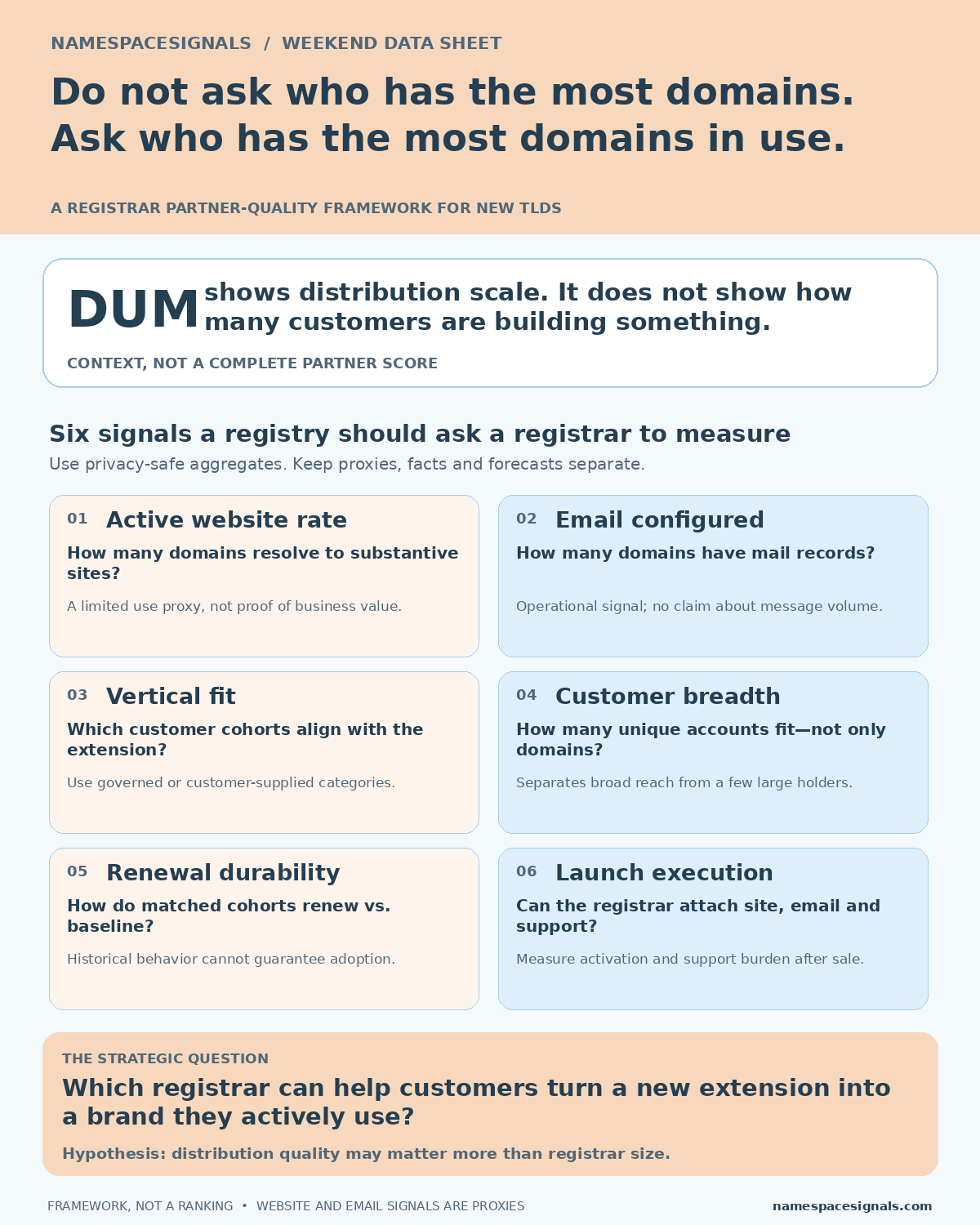
Do not ask who has the most domains. Ask who has the most domains in use.
Domains under management describe distribution scale. They do not reveal which registrar has the highest concentration of customers actively building websites, configuring email, attaching commerce tools or developing a durable brand. Those signals may identify a stronger launch partner than size alone.
A registry may believe it is selling an extension. The customer is choosing an identity to build on. That makes the registrar’s product experience, customer fit and capacity to support activation part of the namespace strategy.
The single-application names may be the channel surprise.
The most crowded strings will attract attention. A registrar’s strongest fit may instead sit among the 723 names chosen by only one mapped group. Lower exact-name overlap does not establish approval or commercial success, but it changes the strategic question from “Which string is hottest?” to “Which string fits customers we already understand?”
Privacy-conscious working rules
- Keep customer-level analysis inside the registrar.
- Share aggregate counts and clearly defined cohorts with registries; do not share customer lists as campaign evidence.
- Separate exact lexical matches from semantic models and allow humans to inspect false positives.
- Do not use public RDAP for prohibited solicitation or high-volume automated querying.
- Date every input. Public monthly registry reports are delayed and cannot describe the registrar’s current book in real time.
Download the discussion dataset
The framework turns each idea into a metric, minimum inputs, recommended output, evidence label and limitation. It contains no customer data.
Public sources and limits
ICANN’s registry monthly reports include per-registrar transaction reports and are published after a three-month confidentiality delay. Monthly Registry Reports · Reporting FAQ.
Public domain-registration data has contractual usage limits, including restrictions involving unsolicited advertising and high-volume automated queries. ICANN: Using Domain Name Registration Data.
Public reports can provide market context and delayed registrar/TLD counts. They do not reveal customer intent, customer identity, a registrar’s live sales pipeline, or the number of customers who would buy a proposed extension.