Who can create demand before checkout?
For a quiet proposed extension, the growth partner may not sell domains. It may own the moment when a customer names a class, fleet, audit, portfolio or service.
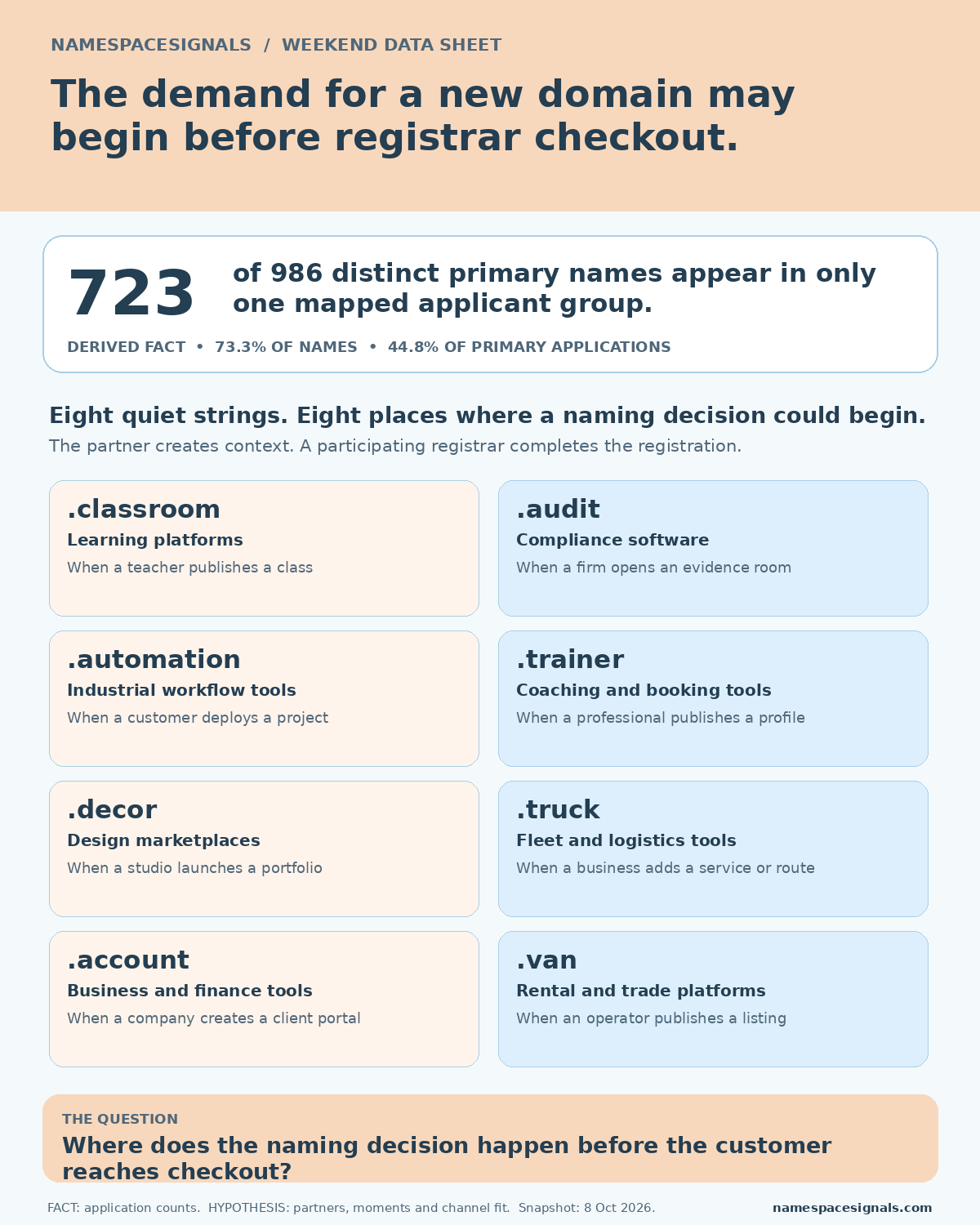
Each example below is a discussion hypothesis built around a primary name with one application and one mapped applicant group in the 8 October 2026 snapshot. It is not an endorsement, partnership claim, launch plan or demand forecast.
Demand can start elsewhere. Registration still has a defined handoff.
ICANN describes registrars as responsible for registering domain names and registry operators as responsible for maintaining the registry for a top-level domain. A registrar also needs a registry–registrar agreement for each gTLD it offers. A third party can create context, education or a qualified lead; the participating registrar or its authorized channel remains the registration path.
Start with the quiet end of the pool
723 of 986 distinct primary names appear in one mapped group. They may have less exact-name rivalry, but that says nothing about evaluation, delegation or demand. It does make them useful for a different question: where could relevance be built into an existing workflow?
Eight partnership plays to test—not copy blindly
- Possible demand partner
- Learning platforms and school-site tools
- Natural moment
- A teacher creates a course, cohort or class page.
- Registrar handoff
- Offer a named class identity, then send availability and checkout to a participating registrar.
- First useful measure
- Published classrooms that start—and complete—the registrar handoff.
- Possible demand partner
- Governance, risk and compliance software
- Natural moment
- A firm publishes an audit portal, evidence room or assurance report.
- Registrar handoff
- Suggest a memorable client-facing address; the registrar checks rights, availability and price.
- First useful measure
- Eligible workspaces, qualified handoffs and activated domains.
- Possible demand partner
- Industrial software, integrators and workflow tools
- Natural moment
- A customer deploys a plant workflow, automation project or integration.
- Registrar handoff
- Turn the project name into an optional public identity, fulfilled by a registrar.
- First useful measure
- Projects with external identity needs, not raw software sign-ups.
- Possible demand partner
- Coaching, certification and booking platforms
- Natural moment
- A professional launches a profile, program or appointment page.
- Registrar handoff
- Place a domain choice beside publishing—not as an unrelated banner ad.
- First useful measure
- Published profiles that attach a domain and remain active.
- Possible demand partner
- Design marketplaces, portfolio builders and trade software
- Natural moment
- A designer or studio publishes a portfolio or project collection.
- Registrar handoff
- Offer a branded address and route the transaction through a registrar or its authorized channel.
- First useful measure
- Portfolio launches, qualified domain searches and activations.
- Possible demand partner
- Fleet, dealer, logistics and service platforms
- Natural moment
- A business adds a vehicle, route, service area or sales listing.
- Registrar handoff
- Test identities tied to fleets and services; keep the registrar as the registration endpoint.
- First useful measure
- Businesses reached, not the number of vehicles in the system.
- Possible demand partner
- Bookkeeping, fintech and business-formation tools
- Natural moment
- A business creates an account portal or financial workspace.
- Registrar handoff
- Use careful eligibility and trust messaging before a registrar availability check.
- First useful measure
- Verified business cohorts, qualified handoffs and support burden.
- Possible demand partner
- Rental, fleet, trade and local-service marketplaces
- Natural moment
- An operator publishes a vehicle, route, conversion or mobile-service page.
- Registrar handoff
- Surface a relevant address inside the listing or setup flow, fulfilled by a registrar.
- First useful measure
- Active operators who publish, search and register.
The strongest partner is close to a naming decision.
A large audience is not automatically a useful channel. A smaller product may be more valuable if its customer is already creating a public identity, launching a project or publishing a page. The useful unit is not “eyeballs.” It is a relevant naming moment with a clean registrar handoff.
What a registry should bring to the table
Partner enablement
- A clear use case and eligibility rules.
- Availability, price and premium-name behavior that can be explained before handoff.
- Co-branded education, test environments and support escalation.
- Attribution that follows the customer into the registrar flow without exposing unnecessary personal data.
- Renewal expectations—not only first-year promotion.
Experiment design
- Start with one workflow and one customer cohort.
- Count qualified handoffs, completed registrations and activated use separately.
- Compare embedded placement with ordinary referral traffic.
- Measure support cost, confusion and failed searches.
- Define stop rules before spending registry marketing funds.
Can the extension become part of the product—not just an ad beside it?
The partner supplies context; the registrar supplies the registration experience; the registry supplies the namespace. If any one step is confusing, the campaign may generate searches without creating durable use.
Questions for the quiet strings
Where does naming already happen?
Which product setup, publishing or onboarding step naturally creates a need for an address?
Who owns customer trust?
Is the third party credible enough to explain the extension without making unsupported promises?
Who takes the order?
Which participating registrar can support the price, restrictions, geography, language and service level?
What proves use?
Will the registry count only registrations, or also configuration, activation, renewal and support burden?
Download the partnership lab
The dataset separates the proposed naming moment, third-party partner, registrar handoff, experiment metric and risk for all eight examples.
Sources, roles and limits
ICANN states that registrars register domain names and registry operators maintain the registry for each TLD. The Domain Name Registration Process.
ICANN’s registrar resources say a registrar must enter a registry–registrar agreement for each gTLD it plans to offer. Registrar Agreements & Policies.
The eight strings and exact-name counts come from NamespaceSignals’ frozen primary-application dataset captured 8 October 2026. Third-party categories and flows are editorial hypotheses. They do not claim that an applicant has selected a model or partner.